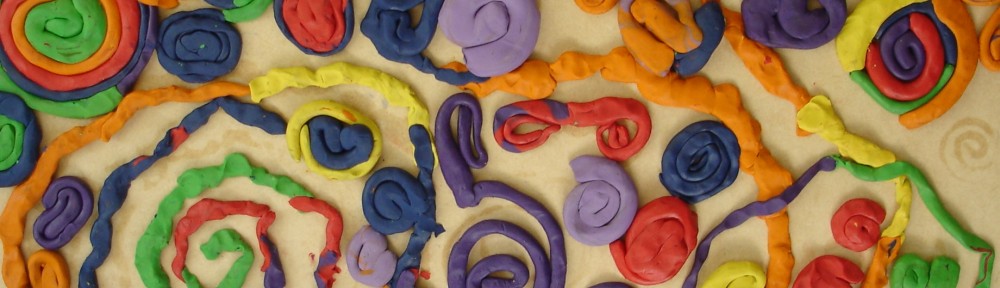
For anyone who is interested in adding more inquiry-based learning to their program but isn’t sure where to start, I highly recommend starting with Art. Art involves creativity, problem solving, making choices, discussion, and is generally open-ended. An excellent resource for dipping into art-based inquiry is: The Language of Art by Ann Pelo.

This week at the Art Studio we were working with wire. The goal was to work the wire into a sculpture of a tree. We have been doing a tree study and I was interested to see how the children might apply what they already know/have learned about trees while they created their sculptures. Wire is not an easy material to work with, save for the fact that it generally stays in the shape that you put it in, so I was also looking for the children to demonstrate some problem solving skills as they completed their pieces.
Here is the provocation I placed at the studio. I happened to have a small wire tree sculpture at home that my husband had received from his former student. The children were quite inspired by it.

Here are some of the comments the children made during their wire exploration:
“I’m making my branches silly by twisting them up. It’s twirly swirly!”
“So my tree is kind of wiggly at the top because I saw some trees have branches like that.”
“I am twisting my wire all around so it can stay up. I had to twist the wires some more to help my tree stand.”
“My tree is dancing!”
“I did it! I got my tree to stand up!”
“Wire is good because it doesn’t break. I need some more wire down here because this part is a little loose.”
Most children wanted to create a tree that could stand on its own. This proved to be quite the challenge, but I was encouraged to see that the children really persevered at the task and were incredibly proud when they achieved their goal.
A sweet moment I was able to capture was between two boys who were working alongside each other at the table:
F: “This is so hard. I can’t do it.”
J: “You have to do it like this!” (modelling twisting the wire)
F: “No, I can’t even do it.”
J: “Look, I’ll show you. You just have to do this (twisting). See? Try again.”
F: “ugh…” (keeps working on it)
J: “Yeah! That’s it! Keep twisting it until it’s nice and strong!”
F: “Like this? Oh, I can do it now! I made a tree!”
Sometimes we all just need a little encouragement from our friends!

 The Curious Kindergarten